
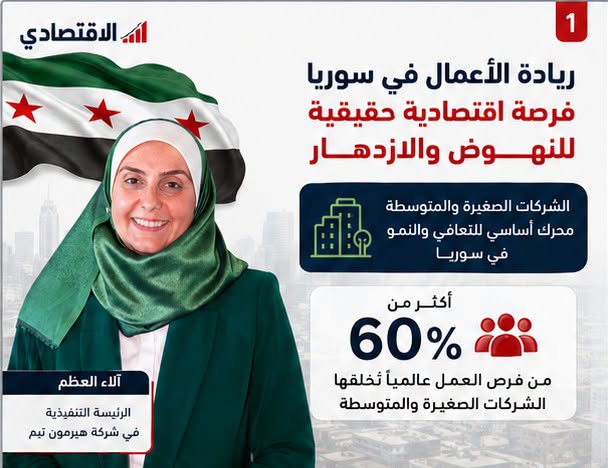
Three Key Barriers Facing Syria’s Entrepreneurship Ecosystem

Alaa Al-Azem, CEO of Hermon Team — a firm specializing in advisory solutions for companies and organizations — spoke with Al-Eqtisadi about the state of entrepreneurship in Syria, identifying three core barriers holding the ecosystem back from meaningful growth.
Three Structural Barriers
The first barrier, Al-Azem explains, is the difficulty entrepreneurs face in accessing bank financing — driven by demanding collateral requirements, the cost of both Islamic and conventional lending, and layers of procedural and bureaucratic complexity.
The second is the absence of non-financial support services for small and medium-sized enterprises (SMEs): government backing on policy and regulation, and capacity-building support in financial planning, marketing, digitalization, and access to external markets.
The third — and, in her view, the most consequential — is the lack of coordination among the institutions that make up Syria’s entrepreneurship community: ministries, organizations, universities, and civil society associations. “The reality today is that each of these actors works in isolation, with no coordination between them,” she notes, “and under these conditions, the ecosystem cannot improve or attract investment.” Building a strong entrepreneurship ecosystem, she adds, requires reforming and updating regulations, and establishing policies and procedures that are both clear and genuinely attractive to entrepreneurs.
SMEs as the Engine of Recovery
Asked how the SME sector could become a real driver of recovery and growth amid Syria’s difficult economic conditions, Al-Azem points to the sector’s global weight: SMEs employ more than 60% of the workforce worldwide — surpassing even large corporations — and have the capacity to move entire value chains across services, crafts, and light industry.
Solving the Financing Gap
On the persistent challenge of access to finance, Al-Azem draws on research conducted at Hermon Team. The findings point to a need for rehabilitating the banking sector — both the Central Bank and commercial banks — alongside simplifying and streamlining procedures.
She also calls for stronger support around collateral: development funds, she argues, should absorb a share of the risk on loans extended to SMEs in the event of default, alongside reduced interest rates that give young companies room to establish themselves. Given the prevailing preference in Syrian society, she stresses the importance of expanding Islamic banking products.
Beyond financing itself, Syrian SMEs need capacity-building in financial management and automation — banks, she notes, cannot extend services to businesses that operate like informal ventures; they need to engage with registered companies that have proper governance and financial records.
ESG and Sustainability: A Distant Priority
Asked about the adoption of Environmental, Social, and Governance (ESG) standards in the Arab region — and in Syria specifically — Al-Azem describes ESG as a relatively recent global concept, one that has gained traction over the past decade as environmental and social risks to companies have grown, amplified by social media exposure of corporate scandals involving issues such as child labor and violations of women’s rights.
The Arab region, she says, remains behind on this front — she is not aware of companies in the region that have adopted a formal ESG framework, despite it being far from a luxury: it is a core determinant of a company’s ability to sustain itself, access financing, and build trust with its community.
In Syria specifically, adopting ESG standards is especially difficult given the pressing economic environment and the many competing priorities companies face — many of which still view sustainability as a secondary concern rather than a necessity.
“The concept of sustainability is still far from the mindset of Syrian companies,” she says, pointing to the need for reliable data infrastructure and the constraints of limited financial resources. Her recommendation is a gradual approach: linking sustainability to more immediate, tangible goals — reducing waste, improving working conditions, and increasing transparency and efficiency — starting from a simplified framework rather than a complex one.
Is Sustainability a Competitive Advantage Yet?
Al-Azem is candid that ESG compliance has not yet become a genuine competitive advantage for companies in emerging markets — nor even, in most cases, in European and American companies, given how new the concept remains. Companies have yet to fully grasp its value in attracting donors or international partners, and it is still largely viewed as a luxury or a “second-stage” development priority rather than a core requirement. That said, she believes the trajectory is clear: ESG is moving toward becoming a genuine competitive advantage over time.
Women’s Economic Empowerment
On the state of women’s economic empowerment in Syria, Al-Azem notes that Syrian women have been pushed into a wide range of sectors as a result of the war and the loss of primary breadwinners. Many turned to micro-enterprises, but scaling from micro to small businesses has proven difficult — constrained by limited access to financing, the need for further capacity-building, and persistent social stereotyping.
Women in family businesses face an additional obstacle, she adds: being sidelined in favor of male relatives, such as brothers. Family businesses in the region also rarely transition into publicly held companies, which frequently leads to their fragmentation amid inheritance disputes.
A Central Driver of Recovery
Asked whether women’s economic empowerment could be a key driver of Syria’s economic recovery, Al-Azem is unequivocal: women now make up more than half of Syrian society, following a sharp decline in the male population due to the war, and represent a substantial share of the workforce. Their role in recovery is therefore essential — not only as economic actors, but as consumers and as primary decision-makers within the household economy.
Coordinated Action for Women’s Participation
Effective coordination between the private sector, international organizations, and government bodies, Al-Azem argues, cannot happen without a proper market study grounded in accurate data — understanding how many women there are, their needs and aspirations, across all age, social, and economic groups, and engaging with them directly as a target audience. Without this foundation, no meaningful services, products, or policies can be built for this segment. Coordination among these three actors on market research and needs assessment should form the basis for shaping future policy.
Advice for Young Syrian Women Leaders
As a woman in a leadership role within consulting and development, Al-Azem offers four pieces of advice to young Syrian women building their own ventures or pursuing leadership positions:
- Don’t work in isolation from other women. Forming support groups — whether around entrepreneurship, employment, or academic paths — is essential, and these groups can evolve into advocacy coalitions capable of pushing governments toward policy and regulatory change.
- Don’t work in isolation from men, either. Building partnerships and alliances with men who genuinely support women’s economic and social roles is key to helping small and medium women-led ventures grow into established companies.
- Financing is not the real barrier — relationships are. The strength of one’s professional network, built through presence in social and business circles, matters as much as capital. Leadership and strategic skills — negotiation, debate, teamwork, communication, and public relations — are best developed through deliberate training.
- Find a mentor. A mentor who can flag the strengths and risks in a decision, help you avoid repeating others’ failures, and offer a different vantage point on a problem is invaluable. The right mentor, she notes, should have at least ten more years of relevant experience than you.
This article was originally published in Arabic on Al-Eqtisadi Syria’s Facebook page. Read the full original article here: https://www.facebook.com/share/p/17Ggq7i5SB/