
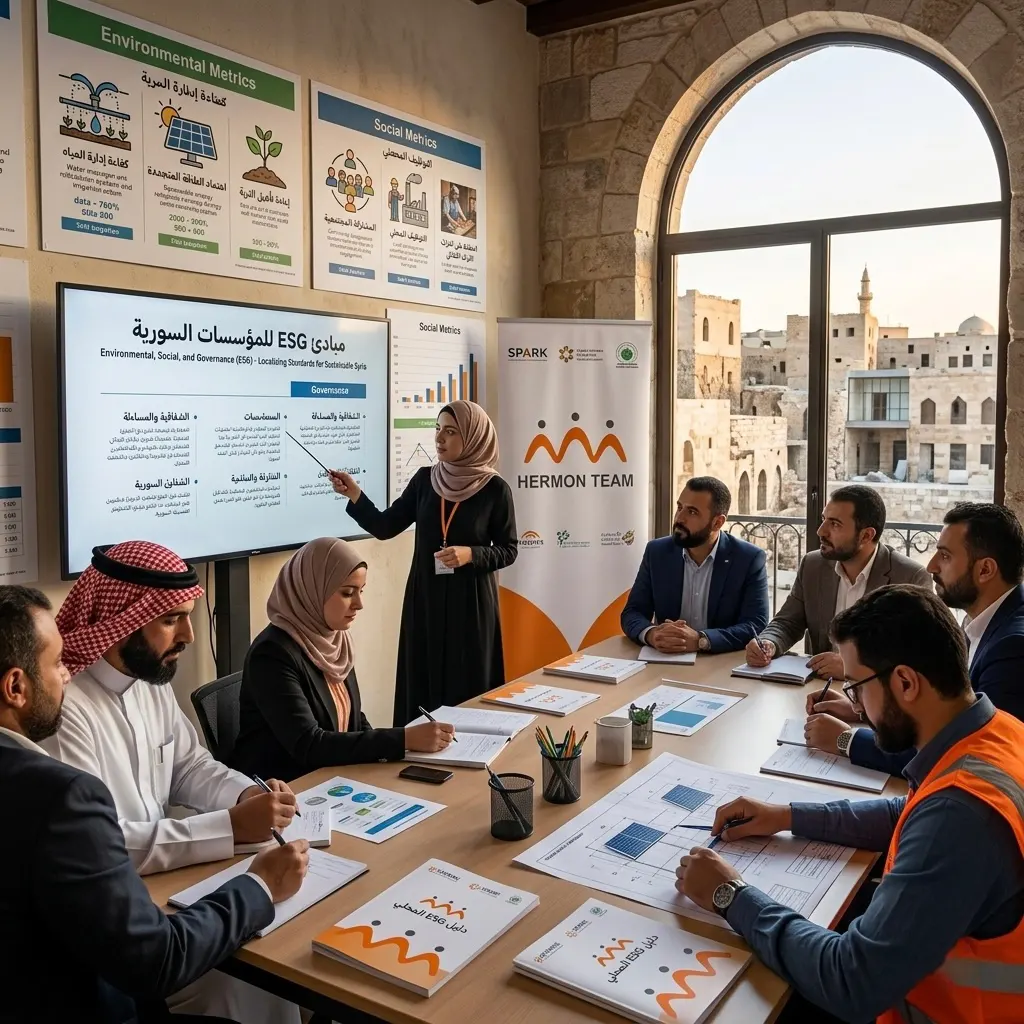
Localizing ESG Principles for Syrian Institutions

In today’s rapidly evolving global landscape, Environmental, Social, and Governance (ESG) principles have become a guiding framework for sustainable development. These principles not only drive internal corporate transformation but also enable institutions to secure the trust and funding of international donors. When localized to the unique context of Syria, ESG can serve as a dynamic bridge between resilient local initiatives and global standards of accountability, transparency, and sustainability.
Adapting the Environmental Pillar
Syria’s environmental challenges are intertwined with its history and current circumstances. Local institutions can customize traditional ESG environmental criteria to prioritize projects that address water scarcity, renewable energy deployment, and sustainable agriculture. For example, initiatives might include rehabilitating irrigation systems with modern, water-efficient technologies or integrating solar solutions in rural energy grids. By contextualizing these practices, Syrian organizations not only manage ecological risks but also showcase proactive stewardship to international donors eager to support green recovery initiatives.
For Syria, environmental challenges are deeply contextual. Localized environmental indicators may include:
- Water Management Efficiency: Measuring improvements in water usage (liters per hectare) after implementing efficient irrigation or water recycling projects.
- Renewable Energy Adoption: Tracking the percentage of energy derived from renewable sources (solar, wind, bioenergy) at local facilities, which is critical in regions facing energy deficits.
- Soil and Land Restoration: Quantifying the success of soil rehabilitation and reforestation projects by assessing soil fertility, vegetation cover, and biodiversity improvements.
These metrics not only reflect immediate environmental needs but help build a conversion framework that aligns with both local realities and international reporting standards.
Embracing the Social Dimension
The heart of any development strategy in Syria is its people. Localizing the social component of ESG means placing community needs, human rights, and cultural preservation at the forefront. Syrian institutions can adopt participatory approaches—engaging local communities in decision-making through inclusive stakeholder meetings and culturally sensitive communication in the native language. This approach, documented in successful localization practices in Northwest Syria, emphasizes the importance of local representation and active participation, ensuring that development initiatives honor traditional practices while addressing modern social needs. Donors are increasingly drawn to strategies that empower local actors and address grassroots challenges, viewing them as sustainable solutions for long-term social resilience.
Social performance for Syrian institutions should capture the human and community dimensions:
- Inclusion and Community Engagement: Develop measures that track participation rates in stakeholder meetings, community consultations, or local advisory boards. This could also include indicators for female participation, youth involvement, and the integration of displaced populations in local development projects.
- Local Employment and Capacity Building: Track the percentage of project beneficiaries who secure employment or receive skills training as a result of ESG initiatives.
- Cultural Preservation: Metrics might involve assessing support for local artisans, preservation projects for cultural heritage, or community art programs, reflecting the unique cultural fabric of Syria.
These indicators ensure that the social impacts of projects are documented in a way that demonstrates both accountability and sensitivity to local societal structures.
Strengthening Governance for Resilient Institutions
Robust governance structures are critical, especially in post-conflict settings. For Syrian institutions, localized ESG governance strategies involve creating transparent, accountable decision-making frameworks that resonate with local norms and expectations. This can include establishing local advisory boards, regular community audits, and participatory planning processes. By aligning governance criteria with local legislative frameworks and societal values, institutions build credibility and foster trust among international donors. Engaging local NGOs and civil society groups not only strengthens governance practices but also supports donor efforts to mitigate risks and ensure funds are managed efficiently.
Robust and transparent governance forms the backbone of institutional credibility. For Syrian institutions, relevant metrics could include:
- Board and Management Diversity: Monitoring the composition and diversity of advisory panels or boards, with a focus on inclusivity and representation of diverse community segments.
- Transparency and Accountability Measures: Evaluating the regularity and clarity of public reporting, including data security, internal audits, and open forums for stakeholder feedback.
- Local vs. International Best Practices: Establishing benchmarks that balance globally recognized reporting standards (like the Global Reporting Initiative) with locally developed indicators, ensuring that governance structures are both accountable and pragmatic in local contexts.
Such tailored governance metrics not only provide a clear picture of institutional performance but also serve as a trust-building mechanism with donors and local communities alike.
Integrating ESG into Donor Engagement Strategies
International donors are increasingly prioritizing ESG-compliant projects, seeking not just financial returns but also long-term socio-environmental impact. By integrating localized ESG principles, Syrian institutions can better tailor proposals and project designs to meet donor requirements. Here are some strategic approaches to consider:
- Customized ESG Assessments: Develop localized ESG metrics that reflect Syria’s distinct environmental challenges, social fabric, and governance realities. These assessments can provide donors with clear benchmarks and progress indicators tailored to the regional context.
- Co-Creation and Capacity Building: Engage local communities and stakeholders in the project design phase. This participatory approach ensures that solutions are culturally meaningful and sustainable while empowering local actors to drive change.
- Transparent Reporting and Monitoring: Establish systems that provide real-time data on ESG performance, integrating qualitative local insights with quantitative measures. Transparent reporting builds donor confidence and supports continuous learning.
- Collaborative Partnerships: Work alongside local experts, NGOs, and international agencies to co-design projects. Emphasizing localization not only ensures that initiatives are contextually relevant but also bridges global standards with grassroots innovation.
Moving Forward: A Roadmap for Sustainable Progress
Localizing ESG principles in Syria is more than an adaptation of a global framework; it is an opportunity to jointly craft a development model that is both resilient and reflective of indigenous practices. By tailoring environmental interventions, reinforcing social cohesion through community engagement, and instituting robust governance practices, Syrian institutions can unlock multifaceted development opportunities. These localized strategies serve as a compelling narrative for donors, demonstrating that investments are built on foundations of inclusivity, environmental stewardship, and transparent management.